

Explore this layout
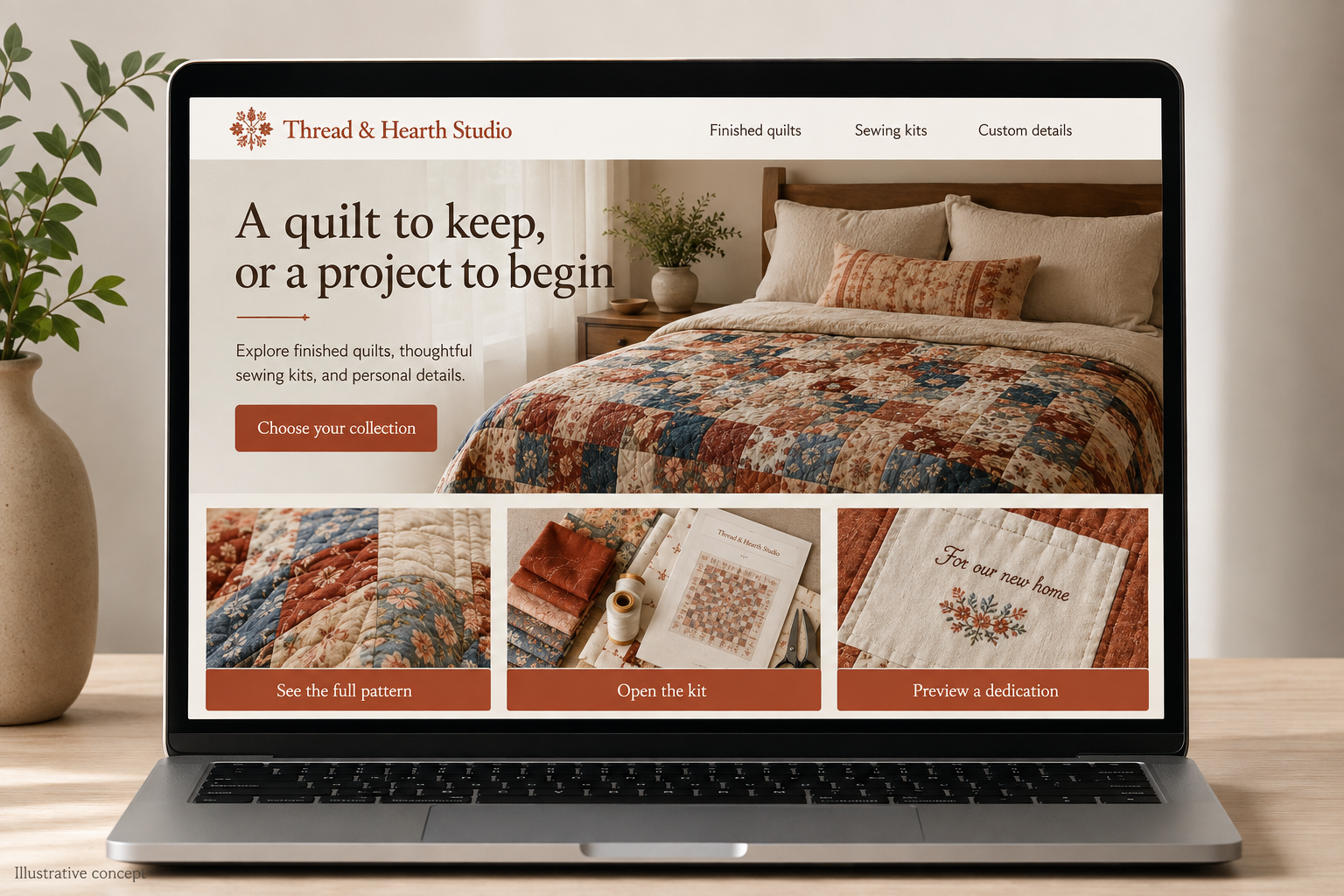
A quilt to keep, or a project to begin
Explore finished quilts, thoughtful sewing kits, and personal details.
The main action is “Choose your collection”. Supporting sections cover See the full pattern, Open the kit, Preview a dedication.
Someone buying a quilt for a new home and someone planning to sew one have different questions. A hypothetical Alabama quilt studio should give each customer an obvious starting point. The finished-piece buyer wants to picture the quilt on a bed. The maker needs to know which materials, tools, and skills the project requires before placing an order.
Keep finished quilts and projects distinct
Use separate collection entrances for finished quilts, quilt kits, and fabric. Label the product type beside the price, including on search results and related-product cards. A photograph of a beautifully finished quilt can easily make a kit look like the completed object. Add an open-box image for kits and list whether backing, batting, binding, and instructions are included. Customers should not discover missing materials only after their parcel arrives.
Give the fabric room to speak
Photograph the whole pattern, a close view of the stitching, and a folded corner that reveals thickness. A bed-size guide should show the actual quilt dimensions and possible overhang rather than relying entirely on labels such as queen. Explain any visible variation between the pictured sample and the available piece. For fabric sold separately, show repeat size and a reference object so a small motif does not look oversized.
Turn personalization into an approval step
For a name, dedication, or custom color arrangement, collect the exact wording in a field that preserves capitalization. Display the requested text again in the order review. Describe when the studio sends a proof, what can still change, and when production starts. If a customer has a fixed gift date, ask for it early. Present a realistic response process without implying that every custom request can be completed on demand.
Create galleries with shopping purpose
A gallery can organize ideas around a baby gift, a reading chair, or a family sewing weekend. Explain why the featured size and construction suit that situation, then link to the relevant finished pieces or kits. This gives discovery pages a purpose beyond collecting photographs. Compare visits that lead to kit purchases with those that lead to finished-quilt inquiries; they represent different audiences and should not share one vague success measure.
Before you launch
- Put “kit” on every kit product card.
- Show actual quilt dimensions in inches.
- Confirm personalized text in the order review.
- List backing and batting inclusion explicitly.
Can a studio use one photograph for a kit and its finished quilt?
It can show the same completed pattern as a reference, but the kit listing also needs its own contents photograph and unmistakable labeling. Explain that the customer will sew the project. Separate prices and collection placement help prevent a finished-object photograph from creating the wrong expectation.