

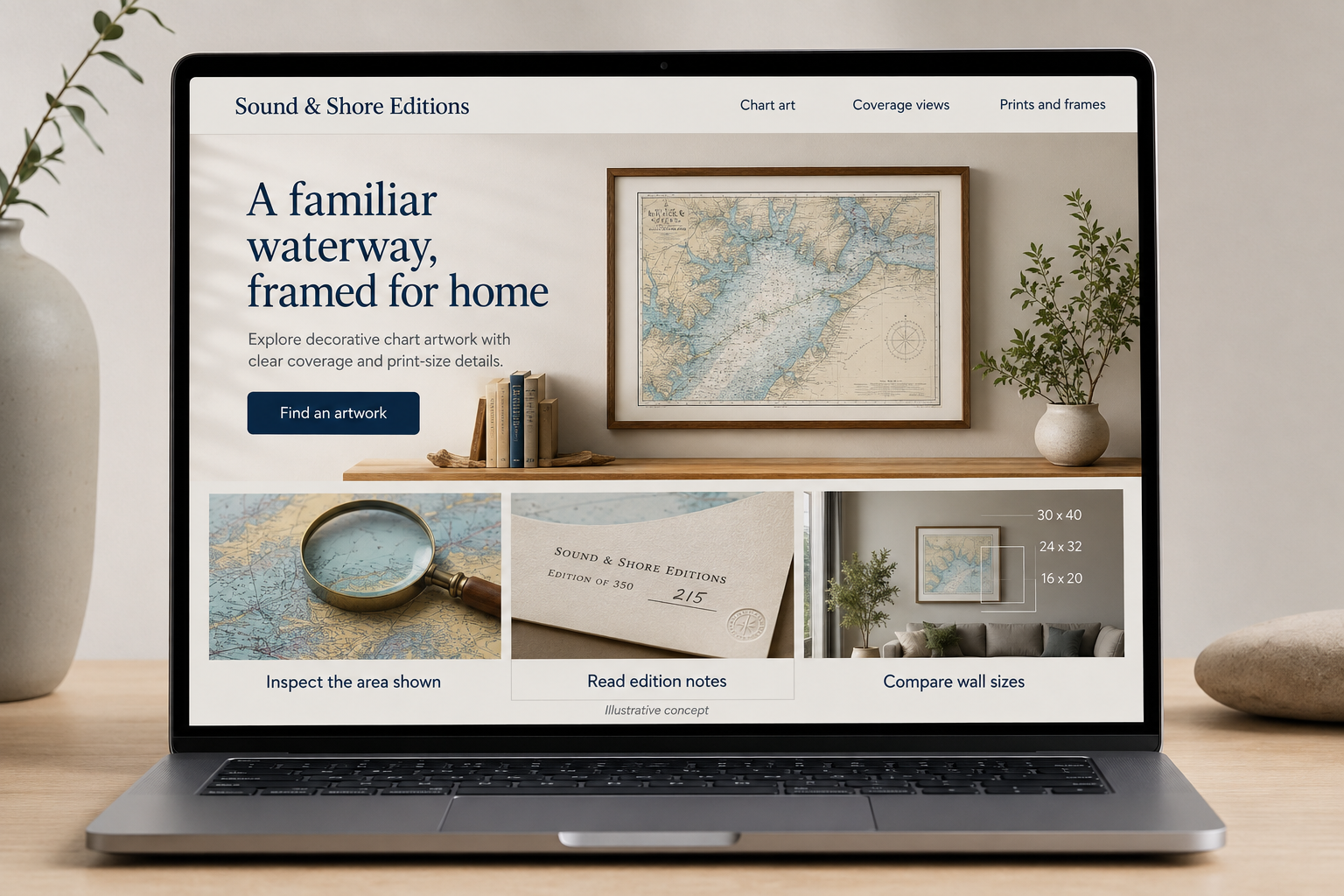
Explore this layout
A familiar waterway, framed for home
Explore decorative chart artwork with clear coverage and print-size details.
The main action is “Find an artwork”. Supporting sections cover Inspect the area shown, Read edition notes, Compare wall sizes.

A decorative chart print can connect a room to a familiar stretch of water, but it should never be confused with equipment for navigation. A hypothetical Maryland art publisher needs to state that purpose clearly. Its shop can then focus on the buying questions that matter: which area appears, how readable the detail will be, and what size arrives at the door.
Identify the artwork and its purpose
Describe each item as decorative artwork and explain the source or creation process accurately. If the piece reproduces older material, give the known date or edition information without implying that it represents current conditions. Keep the decorative-use label on the product page and any close-up image where confusion is likely. Customers should understand whether they are buying a reproduction, an original interpretation, or another clearly described kind of print.
Let shoppers inspect the area shown
Provide a full image and zoomable crops of several labeled details. A coverage preview should make the boundaries of the artwork apparent so a buyer can check whether a particular place appears. Keep the preview legible on a phone and offer a text description of the included area. Do not rely on a room photograph with unreadable artwork to sell a piece whose appeal depends on small names, lines, and geographical relationships.
Show what different sizes actually change
Explain whether larger options enlarge the same image, show a different crop, or add a border. List print dimensions separately from framed outside dimensions. If fine labels become difficult to read at the smallest size, say so in practical terms. Frame choices should include material and finish details with representative photographs. A comparison panel can prevent someone from ordering a small print expecting the readability shown in a greatly enlarged detail image.
Build discovery around recognizable places
Collection pages can organize the publisher’s actual artwork by waterway or depicted area, with short notes that help people choose between overlapping views. Link those pages to a print-size guide and current products. Avoid creating pages for places the catalog does not meaningfully cover. Track searches for missing place names and questions about readability. Those requests can guide future artwork selection and reveal where a coverage preview needs to be clearer.
Before you launch
- Label every chart product as decorative art.
- State known source and edition information.
- Show the artwork’s actual coverage boundary.
- Explain readability limits of the smallest print.
Can decorative chart artwork be described as a navigation chart?
Use wording that accurately distinguishes the artwork from a current navigation product. Explain its decorative purpose and known source or edition. Even if the visual resembles a chart, the shop should not imply that a reproduction is suitable for planning or conducting a journey on the water.