

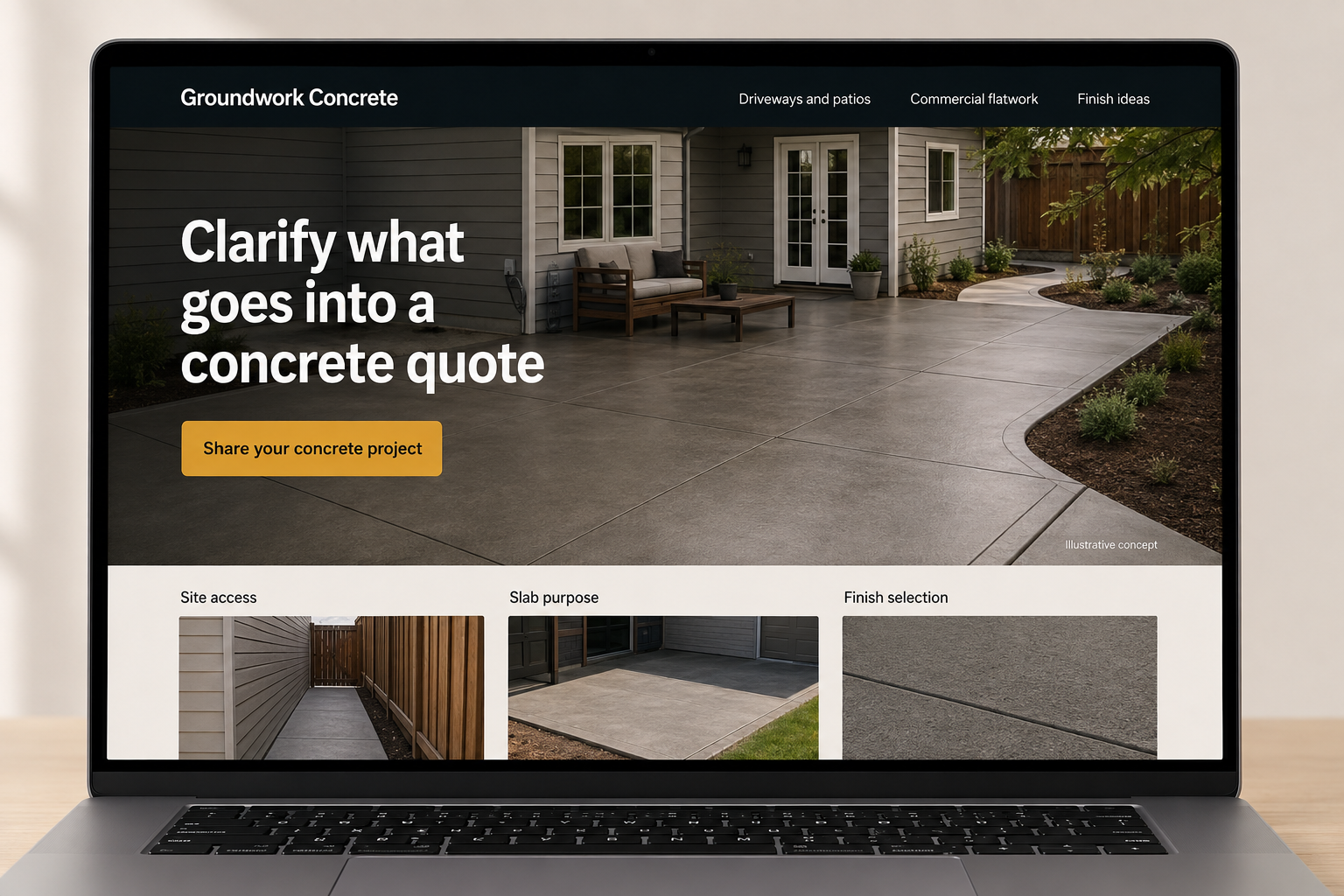
Explore this layout
Clarify what goes into a concrete quote
Explore site access, slab purpose, and finish selection.
The main action is “Share your concrete project”. Supporting sections cover Site access, Slab purpose, Finish selection.
A driveway, a patio, and a commercial slab may share a material while involving quite different project requirements. A concrete contractor's website should make that distinction easy to see. Help visitors identify the kind of work they need, understand the role of site access and preparation, and send a project description that gives the team a useful starting point for an assessment.
Distinguish the purpose of the concrete work
A patio, a driveway, and a working slab have different planning questions. Give each offered service its own explanation of intended use, site conditions, and finish choices. Show photographs with context about the project scope. Do not suggest that an attractive surface tells the whole story. Visitors should see that the proposal depends on the job the concrete must do and the conditions the contractor finds at the site.
Explain what the quote needs to cover
Use a readable process page to describe site review, access, removal or preparation, placement, and finishing at a high level. Mention related work only where the company provides it. Clarify whether customers are asking about new work, replacement, or repair. This prevents a surface level comparison between quotes that may include different tasks and gives the customer a useful list of questions for the first conversation with the contractor.
Let photos support a practical inquiry
Ask for the location, intended use, approximate dimensions, and whether existing material needs removal. A few ground level photos can show access and adjacent areas. Do not require visitors to choose technical specifications they do not understand. Explain that measurements and site conditions need confirmation. The form should work for a small residential project as well as direct larger commercial requests to the person who reviews plans and bid documents.
Attract inquiries through project explanations
A detailed driveway example can explain why access or the connection to nearby surfaces shaped the job, without becoming technical design advice. Link it to the relevant service and estimate request. Track which project pages generate work the company actually accepts. If inquiries repeatedly involve an unsupported finish or project size, make that limitation visible. The best next article often answers a specific question already asked during several recent estimate calls.
Before you launch
- Label flatwork examples by use and finish.
- Include access and approximate project size in inquiries.
- Explain whether removal of existing surfaces is in scope.
- Show where the project assessment fits before a quotation.
Can finish photographs stand in for project descriptions?
They help customers discuss appearance, but they do not explain the work beneath or around the finished surface. Add a short note about the project's use, preparation, and scope. Make clear that a photograph is an example to discuss, rather than a specification for every site.