

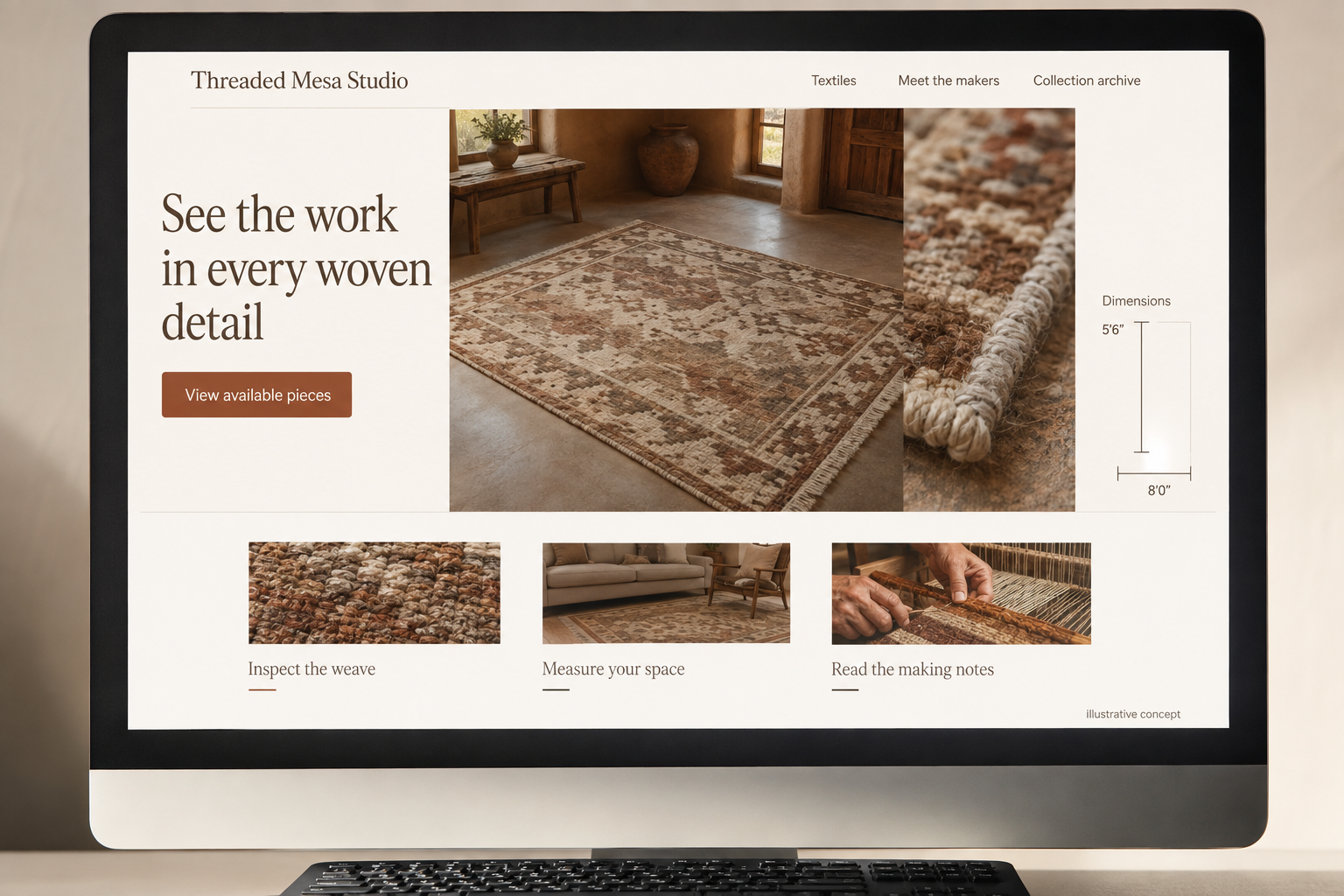
Explore this layout
See the work in every woven detail
Explore individual textiles with maker notes, honest scale, and close views.
The main action is “View available pieces”. Supporting sections cover Inspect the weave, Measure your space, Read the making notes.

A woven textile deserves more than a generic product description about bringing character to a room. A hypothetical New Mexico studio can show who made the piece, what materials were used, and how the actual object looks in detail. The website should support appreciation of the work while giving buyers the practical dimensions and availability they need to choose.
Tell the maker’s story with permission and precision
Use the maker’s preferred name and approved description of their work, with an accurate account of the studio’s relationship to them. Describe techniques only when the information is known and relevant. Avoid assigning cultural meaning, heritage, or community affiliation because a pattern looks a certain way. A short, specific account of the making process can be more valuable than a long romantic story that the seller cannot substantiate.
Show the individual piece from several distances
Photograph the whole textile, a close view of the weave, the edge, and the reverse where that affects its use. For unique pieces, connect those images to the exact inventory item. Explain visible variation and any condition notes in ordinary language. Keep color editing restrained and consistent across the collection. A room illustration may help establish scale, but it should not replace the neutral photograph a buyer uses to inspect the actual object.
Make room planning possible
List dimensions, material composition, weight where useful, and the studio’s care guidance. Explain whether hanging hardware, a cushion insert, or any other staged component is included. If a piece can be displayed in several ways, show the differences without implying that all installation methods suit every wall or surface. A printable measurement guide can help customers compare the textile with the space they have available before making a final decision.
Treat small collections as real inventory
A collection page can explain the relationship between a group of pieces and link to the ones currently available. Mark sold work clearly and avoid placing it in a normal add-to-cart path. Offer an optional collection announcement for people interested in future work, with no promise of an identical replacement. Track inquiries about specific dimensions and techniques. Those questions can guide the next photography session and identify where a maker-approved description needs more detail.
Before you launch
- Use maker-approved biographical descriptions.
- Match unique-piece images to exact inventory.
- Show the reverse and edge where relevant.
- State whether display hardware is included.
Should sold textiles remain visible in the shop?
They can form a useful archive if they are clearly marked as sold and separated from available inventory. Explain that future work may differ and offer a collection notification when appropriate. An archive should help people understand the studio’s work without creating the impression that an unavailable one-of-a-kind piece can still be purchased.