

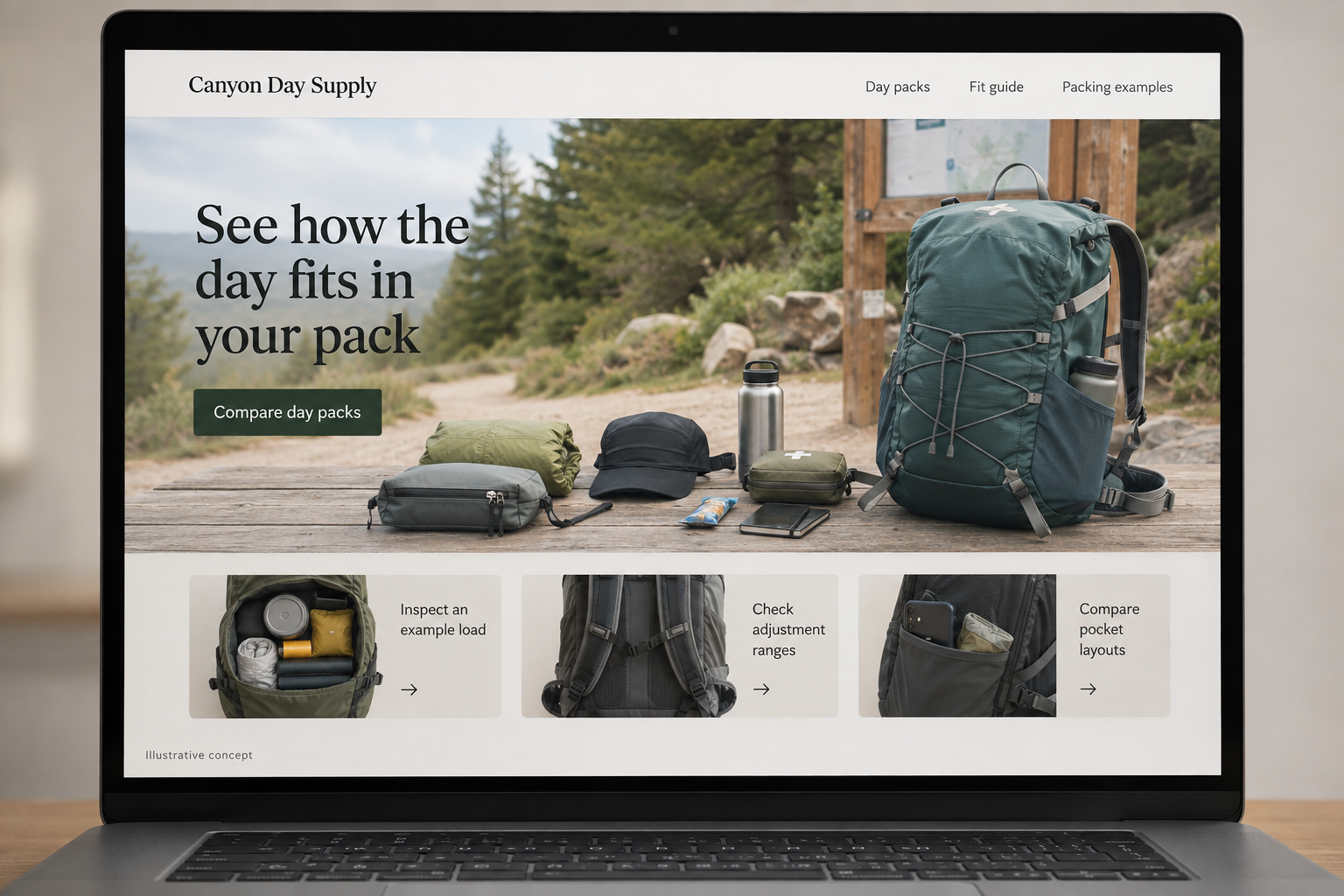
Explore this layout
See how the day fits in your pack
Compare real loads, adjustment details, and the pockets behind the capacity.
The main action is “Compare day packs”. Supporting sections cover Inspect an example load, Check adjustment ranges, Compare pocket layouts.

A day pack’s capacity number does not show how its pockets work or whether its shape suits the load someone carries. A hypothetical Utah outfitter can make those details visible through practical packing examples. The store should help a buyer compare fit and organization for a desert-day-trip concept without implying that any purchase guarantees a safe or suitable outing.
Put the packing example beside the capacity
Show the contents laid out next to the pack, with each item identified and the example load described. State what is included with the product and what is simply being used for scale. Explain how the main compartment and external pockets divide the available space. If the pack supports a separate hydration reservoir, show the relevant dimensions and whether it is included. A capacity figure becomes more useful when the customer can connect it to actual objects.
Make fit adjustment inspectable
Provide the maker’s torso, belt, or strap adjustment information where applicable. Use a simple diagram to show how the relevant measurement is taken and identify the size worn in example photographs. Include side and back views that reveal the harness arrangement. Avoid treating height alone as proof of fit. A clear question route can help someone compare neighboring sizes or understand an adjustment feature before they commit to a product.
Compare tradeoffs in the collection
Present empty weight, dimensions, pocket arrangement, access style, and supported accessories in consistent fields. Explain what changes when moving to a larger model rather than presenting it as automatically better. A compact pack may organize a small load differently from a larger one, and customers need to see that distinction. Keep material and weather-related descriptions tied to the maker’s documentation, with no broad claim that the bag eliminates the need for careful trip planning.
Write preparation pages with a defined scope
A guide can demonstrate how the shop arranged the named items in a particular pack and explain where frequently reached objects sit. Label it as an example, not a universal packing prescription for every destination or condition. Link to the actual model and fit guide. Track comparison use and returns related to adjustment or capacity. If buyers frequently misunderstand a pocket’s size, a better image will help more than another general article about exploring the outdoors.
Before you launch
- Identify every object in packing photographs.
- State whether a reservoir is included.
- Show the maker’s actual adjustment ranges.
- Compare pocket arrangements across pack sizes.
Can a pack’s liter rating tell a shopper everything about capacity?
It provides a useful comparison point, but shape, openings, and pocket layout affect what can be carried comfortably. Show a labeled example load and the relevant dimensions. Customers should be able to compare their own objects with the illustration rather than assuming equal capacity numbers mean identical usable arrangements.