
Explore this layout
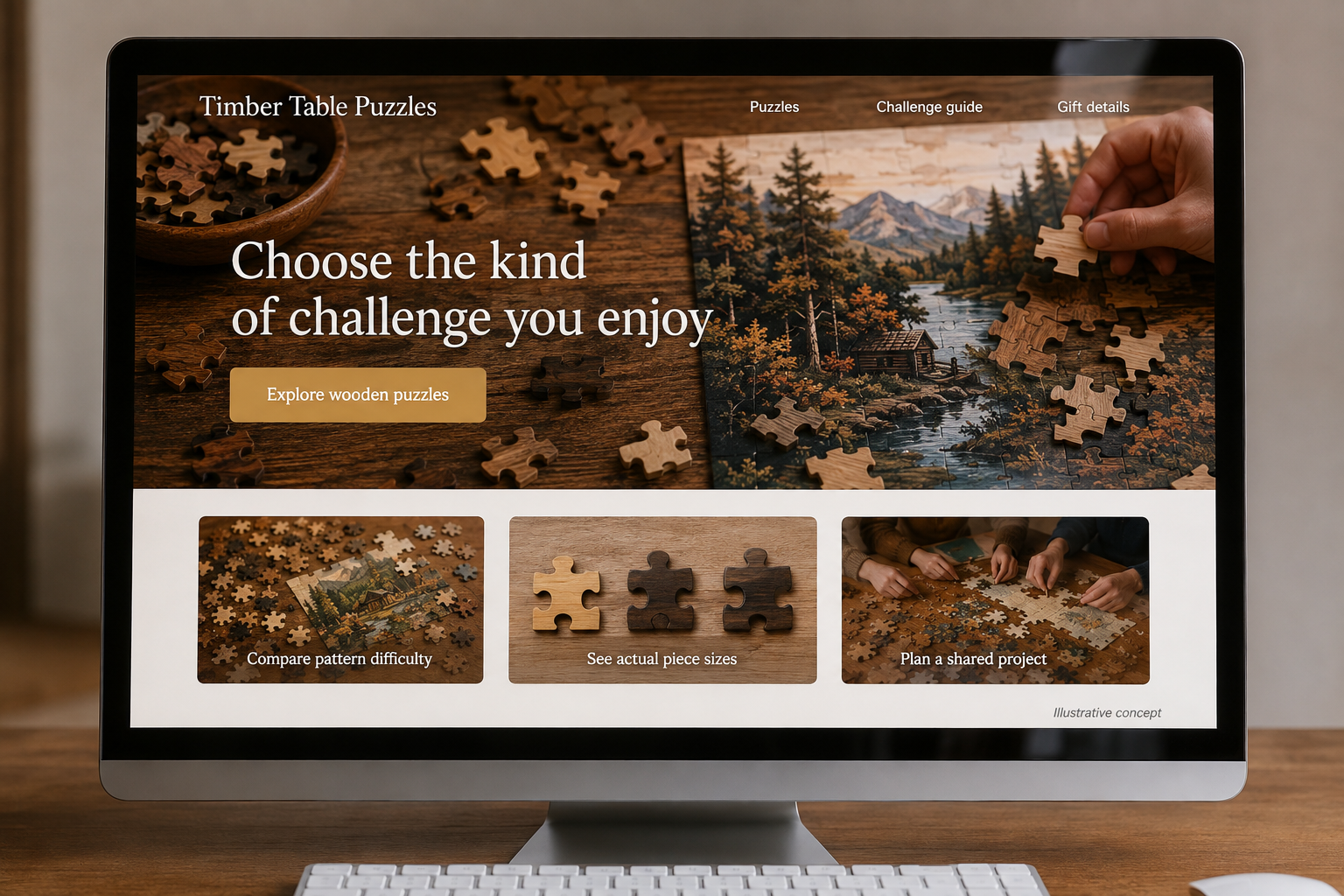
Choose the kind of challenge you enjoy
Compare pieces, picture the footprint, and find a project to keep on the table.
The main action is “Explore wooden puzzles”. Supporting sections cover Compare pattern difficulty, See actual piece sizes, Plan a shared project.
A wooden puzzle can be a quiet gift for one person or something a family leaves on the table over several evenings. A hypothetical Vermont maker should help shoppers picture the activity, not simply admire the finished image. Piece size, pattern, construction, and the maker’s stated age guidance belong beside the artwork because they influence who will enjoy the challenge.
Explain the challenge in concrete terms
Describe piece count, shape variation, image repetition, and any other feature that affects the maker’s intended difficulty level. If the collection uses a scale, explain the differences within that collection rather than promising a fixed completion time. Show a sample grouping of pieces at a useful size. A buyer choosing for someone else can make a better comparison from those details than from a label such as easy or expert on its own.
Show the physical pieces and finished footprint
Provide finished dimensions and representative piece measurements, with close photographs of edges and surface printing. Use the maker’s actual material information and stated age guidance. Keep any relevant product warnings accessible without replacing them with assumptions based on a friendly illustration. Explain whether the frame, sorting tray, or display board shown in photographs is included. The product page should make the object’s scale and contents clear before the buyer chooses a gift message.
Make gift planning about the recipient’s activity
Offer browsing paths for a compact table, a longer shared project, or a small travel-friendly format where those products exist. Avoid assigning ability or taste solely by age. Show the packaging and the exact personalization available, if any. Explain the maker’s production and dispatch process for customized pieces. A buyer with a fixed date needs to understand when a request is still being reviewed and when the order is actually ready to move forward.
Build a library of useful puzzle comparisons
An article can compare two puzzles with the same piece count but different image patterns, explaining why the experience may differ. Link to actual products and show authorized close-ups that support the comparison. Offer a missing-piece or product-question route if the maker has a process for it. Track difficulty-related questions, gift orders, and requests about piece size. These signals can guide clearer descriptions and help the right customer discover a suitable project.
Before you launch
- Explain difficulty factors beyond piece count.
- Show representative pieces at real scale.
- Keep the maker’s age guidance visible.
- Label display boards or trays sold separately.
Should difficulty be described with an expected completion time?
A time estimate can vary widely between people and settings. It is usually more useful to describe piece count, shape, image repetition, and the maker’s own comparison scale. If a completion example is included, identify the circumstances rather than presenting it as a result every buyer should expect.