

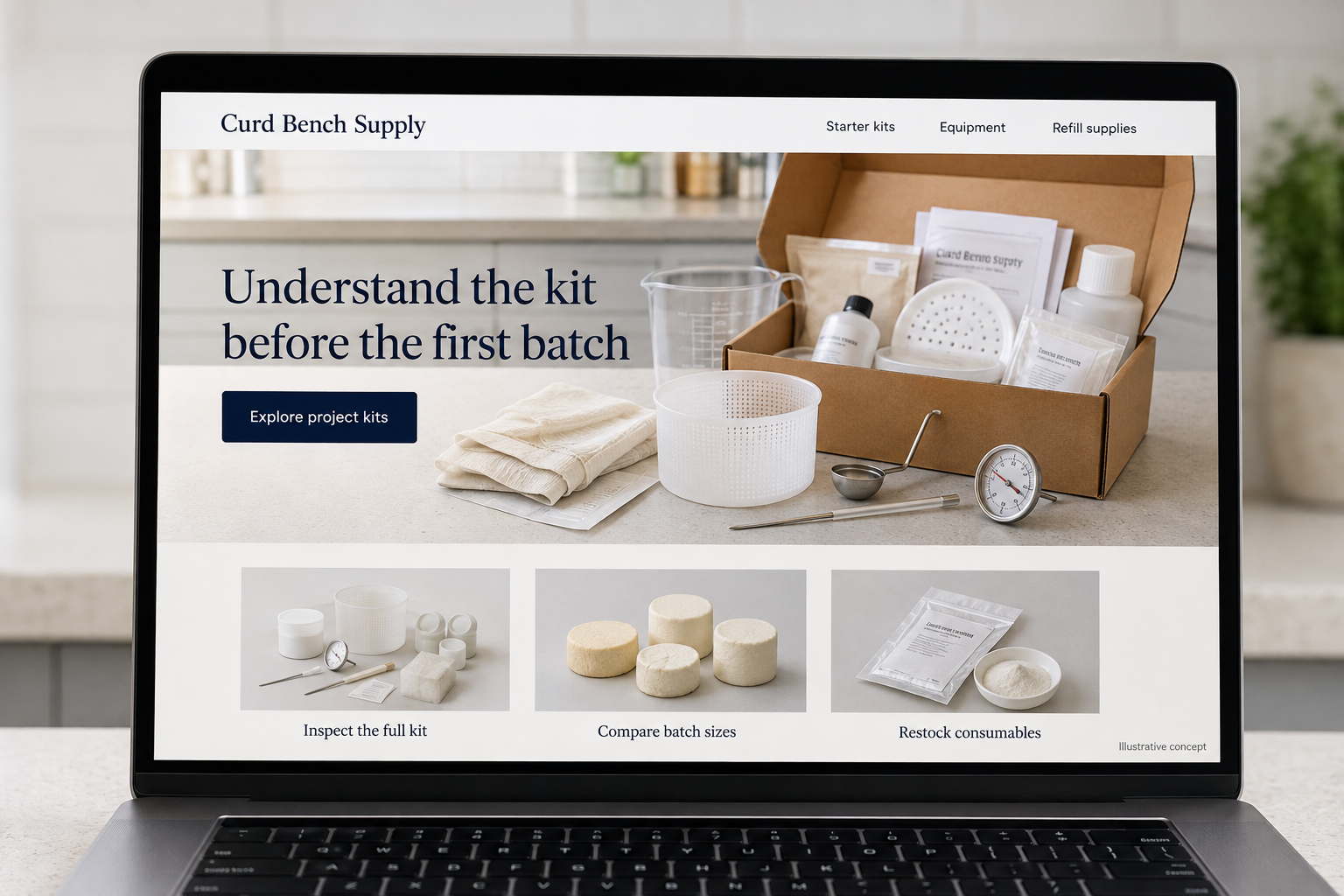
Explore this layout
Understand the kit before the first batch
Compare equipment, inspect the contents, and follow a clearly defined project.
The main action is “Explore project kits”. Supporting sections cover Inspect the full kit, Compare batch sizes, Restock consumables.

A home cheesemaking project brings together reusable equipment, ingredients, and instructions that do not all belong in the same box. A hypothetical Wisconsin supply shop should make those boundaries clear. The store can help a beginner choose a documented project and a manageable equipment set while giving returning customers a quick route to the supplies they need again.
Start with a clearly described project
Organize starter paths around the projects the supplier’s instructions actually cover. Show the intended batch size and the equipment used in the example, with a simple overview of the process rather than an unsupported promise of an easy result. Identify the prior knowledge the instructions assume. A buyer should be able to tell whether they are purchasing a complete supported project pack or only a tool that will require a separate recipe and ingredients.
Separate equipment from consumables
List each included item, its quantity, and whether it is reusable. Explain what the customer must obtain separately, including ingredients or kitchen equipment used in the demonstration. Show the open kit with labels that match the contents list. Keep storage and handling information supplied by the product makers accessible. A photograph of a finished food is an example of the project, so it should not create the impression that every required material arrives in the purchased package.
Compare dimensions and capacities directly
Give actual dimensions and stated capacities for molds, containers, and other relevant tools. Identify compatibility with the supplier’s documented examples rather than implying every recipe uses interchangeable equipment. When one tool comes in several sizes, explain how the example projects differ and let customers compare them in one panel. Keep replacement components linked from the original product. Buyers with equipment already at home need a precise way to determine what they still lack.
Give the second project an easy starting point
A saved project list can distinguish the equipment already purchased from consumables needed again. Link instructions to the exact products they use and update those links when the catalog changes. Keep food-handling directions grounded in appropriate product documentation rather than improvising broad advice in marketing copy. Measure incomplete-kit questions and repeat-supply orders. If customers repeatedly ask whether a certain ingredient is included, change the contents photograph and product summary before expanding the blog.
Before you launch
- Label reusable and consumable kit components.
- Show ingredients that must be obtained separately.
- Match project instructions to exact equipment sizes.
- Link replacement supplies from original kits.
What makes a starter kit feel complete to a first-time buyer?
Clarity matters as much as the number of items. Show every included component and list everything the customer must supply separately. Tie the kit to a specific set of instructions and batch size. A smaller, well-explained pack can be easier to evaluate than a large assortment with unclear relationships between its contents.