

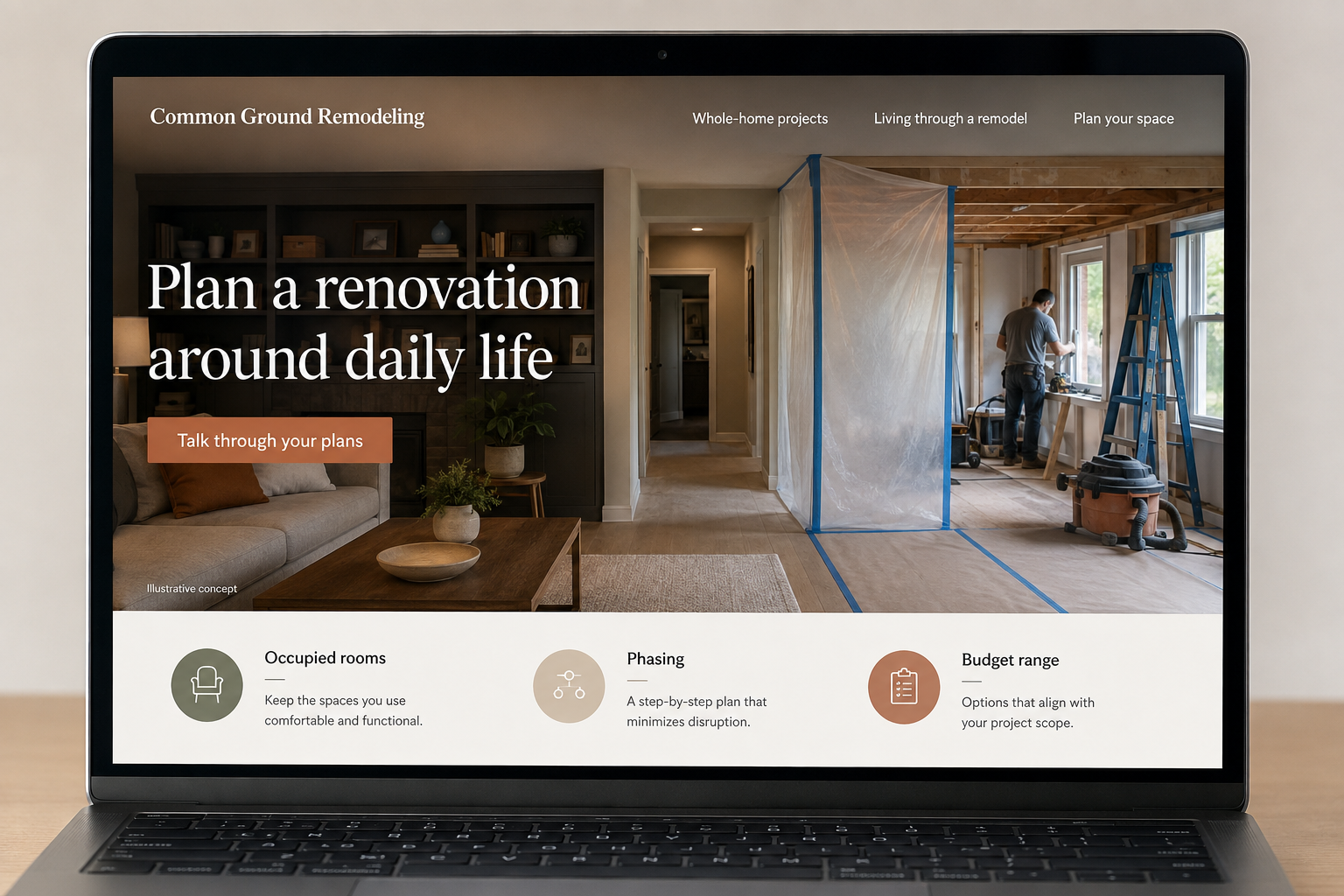
Explore this layout
Plan a renovation around daily life
Explore occupied rooms, phasing, and budget range.
The main action is “Talk through your plans”. Supporting sections cover Occupied rooms, Phasing, Budget range.
People thinking about a remodel are imagining a better home and wondering what they will have to live through to get it. The website should make room for both feelings. Show finished rooms, then explain the decisions, sequencing, and household disruption behind the photographs. Someone who understands your process can approach the first conversation with more useful questions and a more realistic brief.
Talk about the house during the work
Remodeling customers are buying a result while worrying about the weeks in between. Explain how occupied homes are discussed during planning: access to rooms, work areas, storage, and the order of tasks. Avoid promising a disruption free project. A short example of how a family might plan around a phased renovation gives visitors more useful context than a row of finished rooms with no captions.
Organize examples by the problem solved
A portfolio can group projects by goals such as opening shared living space, improving storage, or updating several rooms together. Explain which parts of the home changed and why the owners chose that approach. Show before images only with permission and label them clearly. Include enough context to distinguish a cosmetic refresh from a layout change so prospective customers do not assume every example has the same scope.
Let the customer describe their priorities
An inquiry should ask which areas need work, what is frustrating about the current home, and whether the owner expects to remain there during construction. Give visitors room to explain competing priorities. A wish list is often more useful than forcing a precise budget before a conversation. Tell them whether the next step is a phone discussion, a home visit, or a review of existing plans.
Build content around real planning decisions
Useful articles can explain how to prepare a renovation brief, compare doing rooms together with phasing them, or gather reference images that communicate a preference. Link each guide to the relevant service and a planning inquiry. Track whether these readers become suitable consultations. When the same question appears repeatedly in calls, improve the service page before adding another broad article about the general benefits of remodeling.
Before you launch
- Pair each finished room with its starting problem.
- Show which parts of an occupied home may be affected.
- Separate whole-home work from individual room projects.
- Let owners describe their planning stage without uploading drawings.
Should we show projects before every finish is selected?
An in-progress story can be useful if it explains a decision or a construction sequence. Label the stage clearly and obtain the owner's permission for the material you publish. Keep finished project examples easy to find, while using progress stories to explain what working with your team actually involves.