

Find a game for your table Browse by people, time, and the kind of evening you want to have. The main action is “Choose a game”. Supporting sections cover Two-player evenings, Learn-to-play sessions, Base games and expansions.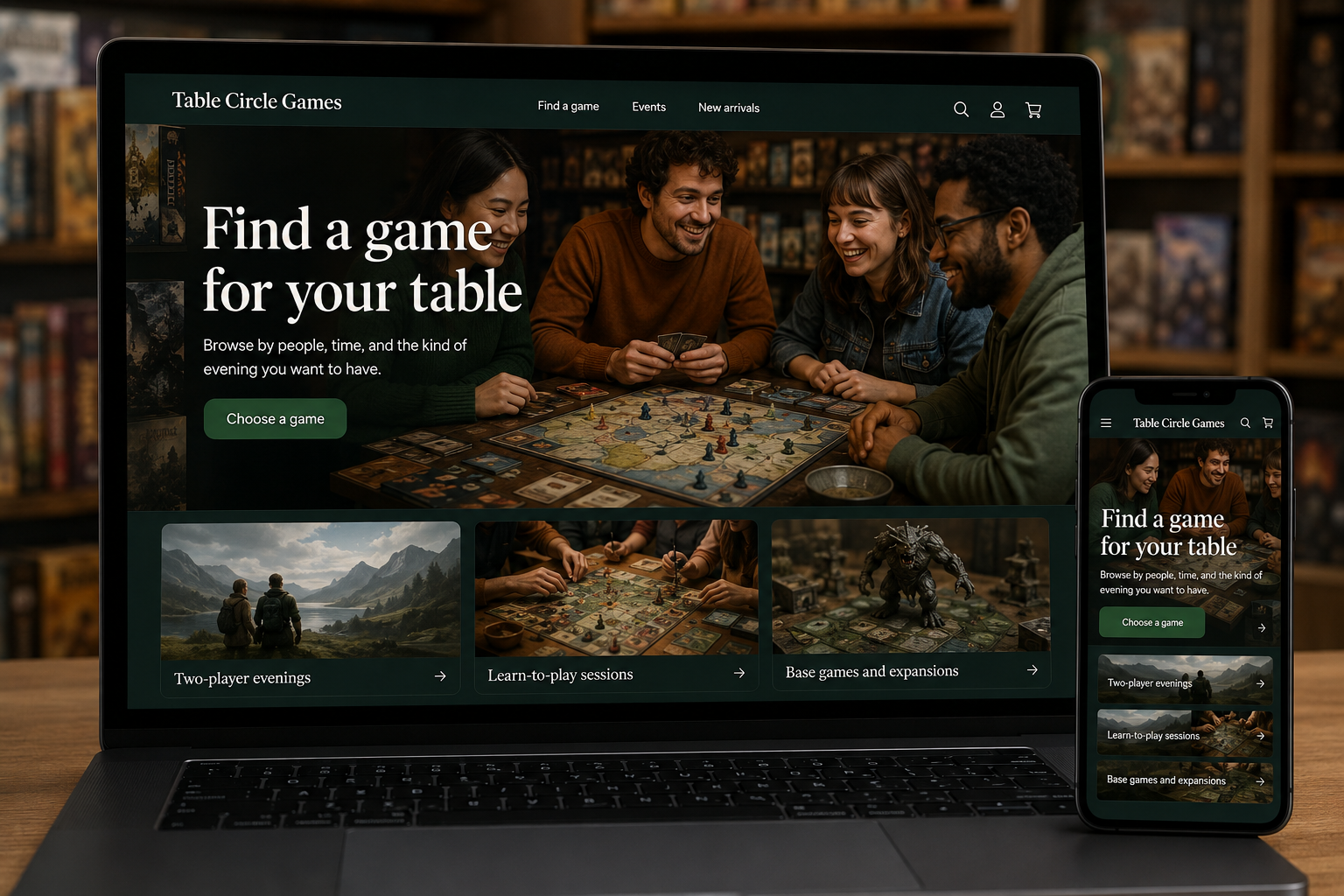
Explore this layout
The best game for a household is not always the newest release or the one with the most elaborate box. People need to know whether it suits their group, table, available time, and appetite for learning rules. A shop website can make those decisions enjoyable by describing the play experience clearly and separating useful facts from promotional excitement.
Filter for the actual game night
Let shoppers narrow by player count, approximate playing time, and the kind of interaction they enjoy. Explain complexity labels in your own consistent terms rather than assuming every customer interprets them alike. Distinguish cooperative play, direct competition, and conversation-led party games. Where a game technically supports two players but the shop recommends a different group size, label that as a staff view and explain the reasoning without treating it as a universal rule.
Keep editions and expansions straight
Identify the edition, language, and whether a listing is a complete game or an expansion requiring another product. Show essential compatibility information near the buying action. List included components where that helps comparison and explain any preorder arrangement separately from available stock. A customer should not have to read a forum to discover that the interesting-looking box in their basket cannot be played on its own that evening.
Make community events welcoming
Each event page needs a date, time, location, cost if any, and an explanation of who can join. Say whether rules will be taught, whether players must bring a game, and whether spaces require registration. Distinguish a casual learn-to-play evening from an organized competition. Add practical details such as expected session length. A newcomer can then decide to attend without already knowing the shop's regulars or the vocabulary of the hobby.
Recommend with a reason
Write small collections around recognizable situations: a quick game before dinner, a cooperative evening, or something portable for a trip. Explain why each choice fits and link to current stock. Measure recommendation-to-product visits, purchases, and event registrations separately. Ask staff what customers misunderstood after reading a page. Better information about rules, reading demands, or table space can improve a recommendation more than adding another enthusiastic adjective to the description.
Before you launch
- Flag expansions beside purchase controls
- Show game language and edition
- Explain event teaching arrangements
- Test player-count filters
Should the website use a single complexity score?
A score can be a shorthand, but a brief explanation is more useful. Describe how much rules learning, reading, and strategic planning a game involves. Different groups find different things difficult, so give shoppers enough context to interpret the label for themselves.