

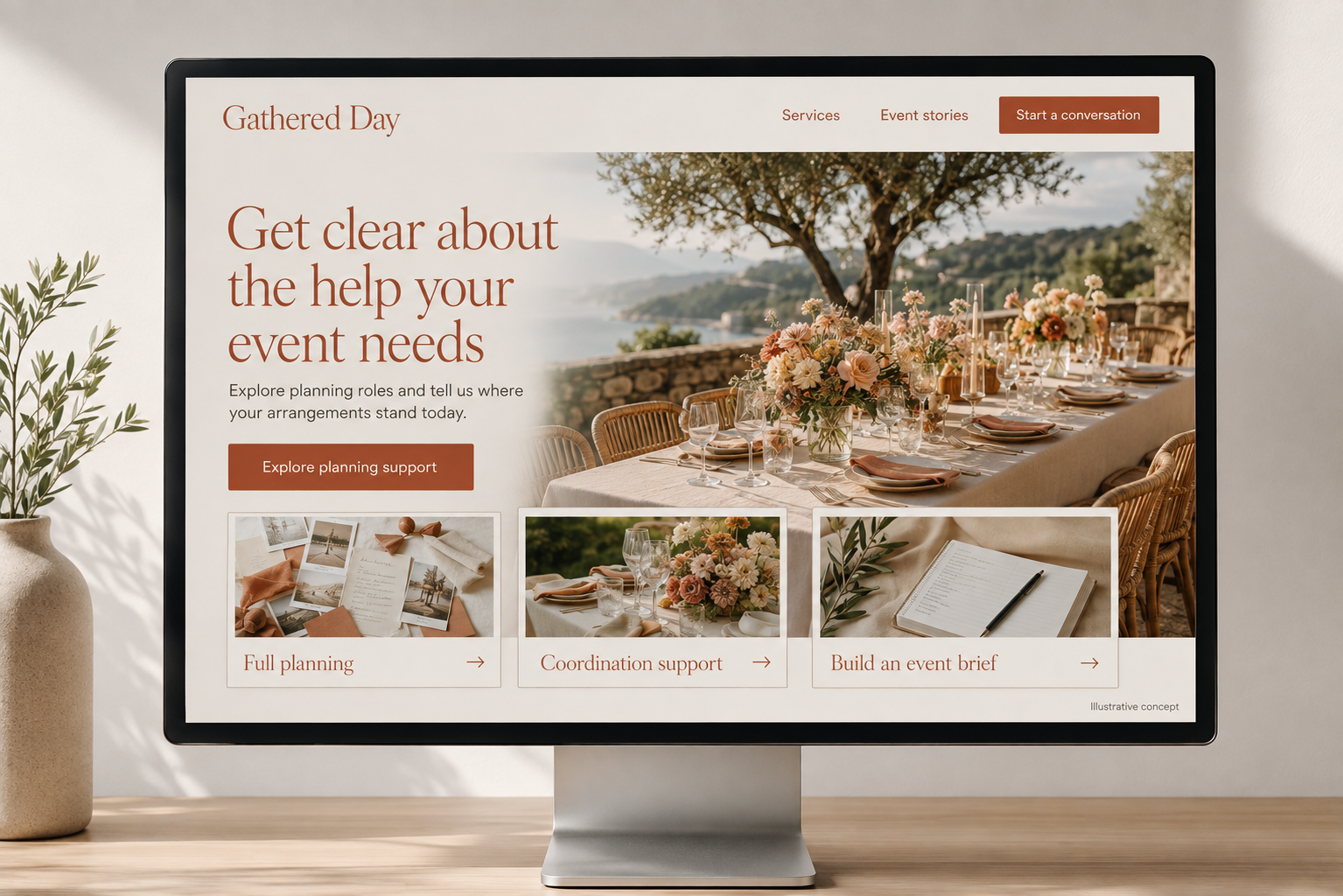
Explore this layout
Get clear about the help your event needs
Explore planning roles and tell us where your arrangements stand today.
The main action is “Explore planning support”. Supporting sections cover Full planning, Coordination support, Build an event brief.
People approach an event planner at very different stages. Some have only a date and an idea; others have booked suppliers and need help bringing the arrangements together. The website should explain which kinds of support the planner provides and when each is useful. Clear scope makes the first conversation more productive than a gallery that suggests the planner handles everything without qualification.
Distinguish planning from coordination
Describe full planning, partial support, and event-day coordination only where those services are genuinely offered. Explain the starting point and responsibilities for each, including what the client already needs to have arranged. Avoid relying on package names that reveal little about the work. A customer should be able to tell whether they are asking for concept development, supplier communication, schedule management, or another defined role before completing an inquiry.
Show examples with the role made clear
Use real, permission-cleared project stories that explain the event's purpose, constraints, and the planner's contribution. Credit suppliers appropriately and label concepts or styled shoots accurately. Photographs should support a description of the work rather than imply that every visible element was provided by the planner. A prospective client can learn from how a guest flow or schedule was organized, even when their own event has a different appearance or scale.
Gather a brief that reflects the stage of planning
Ask for the event type, date or flexibility, location, expected attendance, and what has already been arranged. An optional budget range and a description of the help needed can guide the response. Let customers indicate that key decisions remain open. Explain how the initial inquiry leads to a consultation and proposal. The form should not suggest that a date is secured before the planner has reviewed availability and the scope of involvement.
Publish guidance that clarifies responsibilities
Write useful pieces about preparing information for a planning consultation or distinguishing venue coordination from an independent planner's role, based on the actual service being described. Avoid making universal claims about what every venue or supplier provides. Measure suitable inquiries and consultations that progress to defined proposals. If requests regularly assume tasks outside the offer, strengthen the service boundaries. Better content helps clients understand where support fits into their plans and what they still need to arrange.
Before you launch
- Explain the starting stage for each service
- Credit suppliers in project stories
- Ask what is already booked
- Clarify date-hold arrangements
Should an event planner list every supplier they know?
A curated list can help if relationships and permissions are clear, but it should not replace the explanation of the planning service. Clients need to understand how supplier selection works for their event. Avoid implying exclusivity, guaranteed availability, or endorsements that have not been agreed and maintained.