

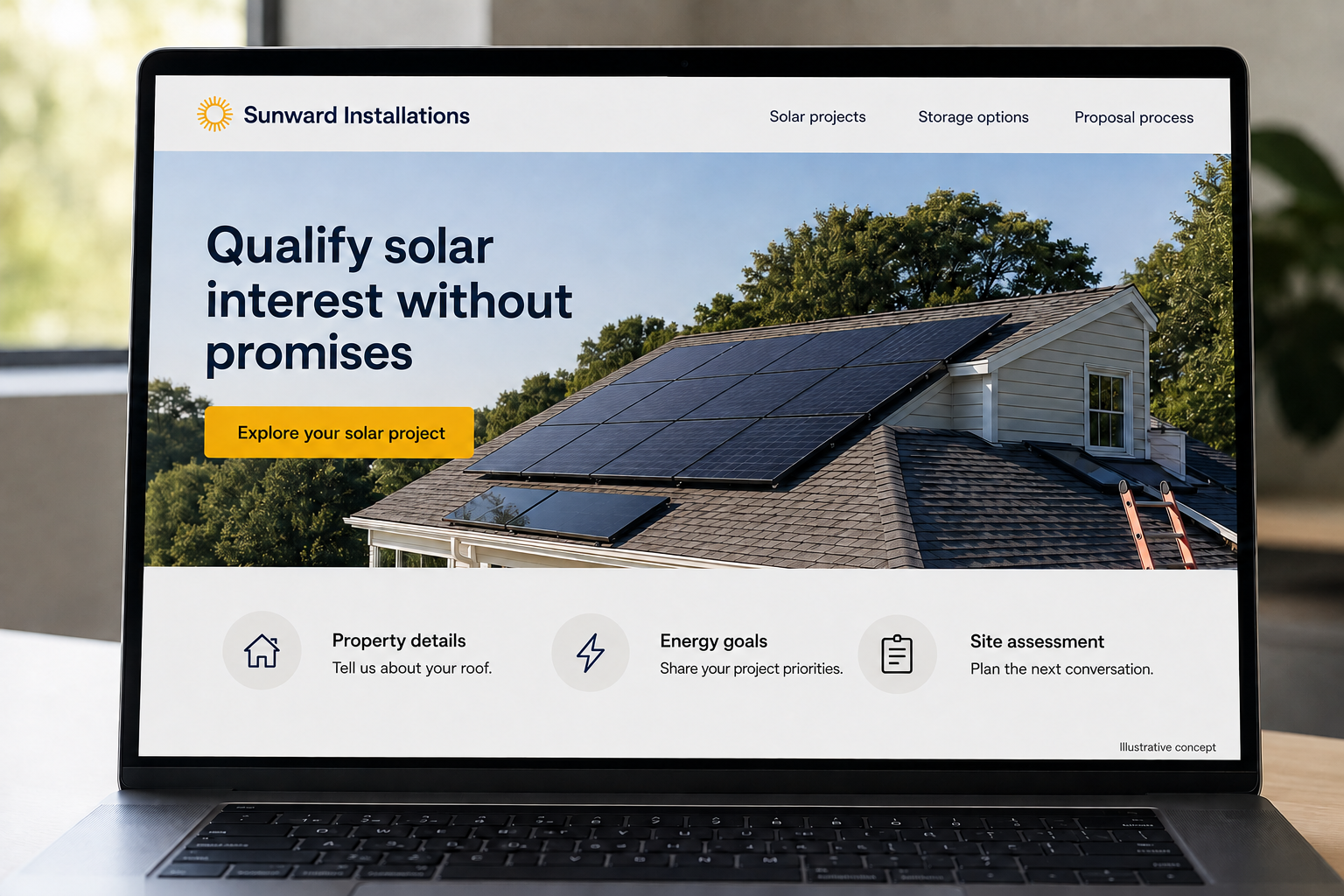
Explore this layout
Qualify solar interest without promises
Explore property details, energy goals, and site assessment.
The main action is “Explore your solar project”. Supporting sections cover Property details, Energy goals, Site assessment.
People comparing solar installers need help understanding the proposal process before they can make sense of equipment lists. A good website explains the information the team reviews, the stages of a project, and the choices the customer will discuss. Keep examples grounded in their actual assumptions, and give visitors an inquiry route that does not require them to predict a system size themselves.
Begin with the property and the customer’s goal
Some owners want to understand solar for a future project; others are ready for a site review. Let the website welcome both without promising savings or a particular payback period. Ask what the customer hopes to achieve and which property is involved. Explain the difference between a preliminary conversation and a system proposal. A visual concept can show the parts of the customer journey rather than a fabricated production estimate.
Explain what shapes a proposal
Describe the information the installer reviews, including the building, available space, energy use, and the intended system. Keep equipment comparisons readable and identify the actual products offered. Any current incentive or financing information needs a maintained source and clear terms; the page can simply link to verified details. Avoid a calculator that presents an illustrative result as a quote or assumes every property can support the same installation approach.
Make the first form proportionate
Start with location, property type, ownership or decision role, and the broad goal. Request energy documents only through an appropriate private process and explain why they are needed. Let early stage visitors ask a question without uploading a bill. The confirmation should say whether the next step is a phone discussion or a site review, and should not suggest that a system has already been designed from the form answers.
Use project context instead of broad promises
Where permission exists, show real installations with clear descriptions of equipment and scope, avoiding unsupported claims about the customer’s financial outcome. Educational pages can explain how to prepare questions for a proposal review or distinguish equipment choices. Track which readers become suitable consultations and where expectations differ from the offered service. Keeping those explanations accurate is more valuable than filling the site with claims that every roof will deliver the same result.
Before you launch
- Explain the information needed for a preliminary project review.
- Label assumptions behind any illustrative performance example.
- Distinguish installation work from ongoing support arrangements.
- Let customers indicate interest in storage without selecting equipment.
Should solar visitors receive an immediate savings estimate?
An initial illustration can start a conversation if its inputs and limits are visible. Avoid presenting it as a personalized outcome when the property, usage, and project details have not been reviewed. Explain what information is still needed and how the customer will receive a more specific proposal.