

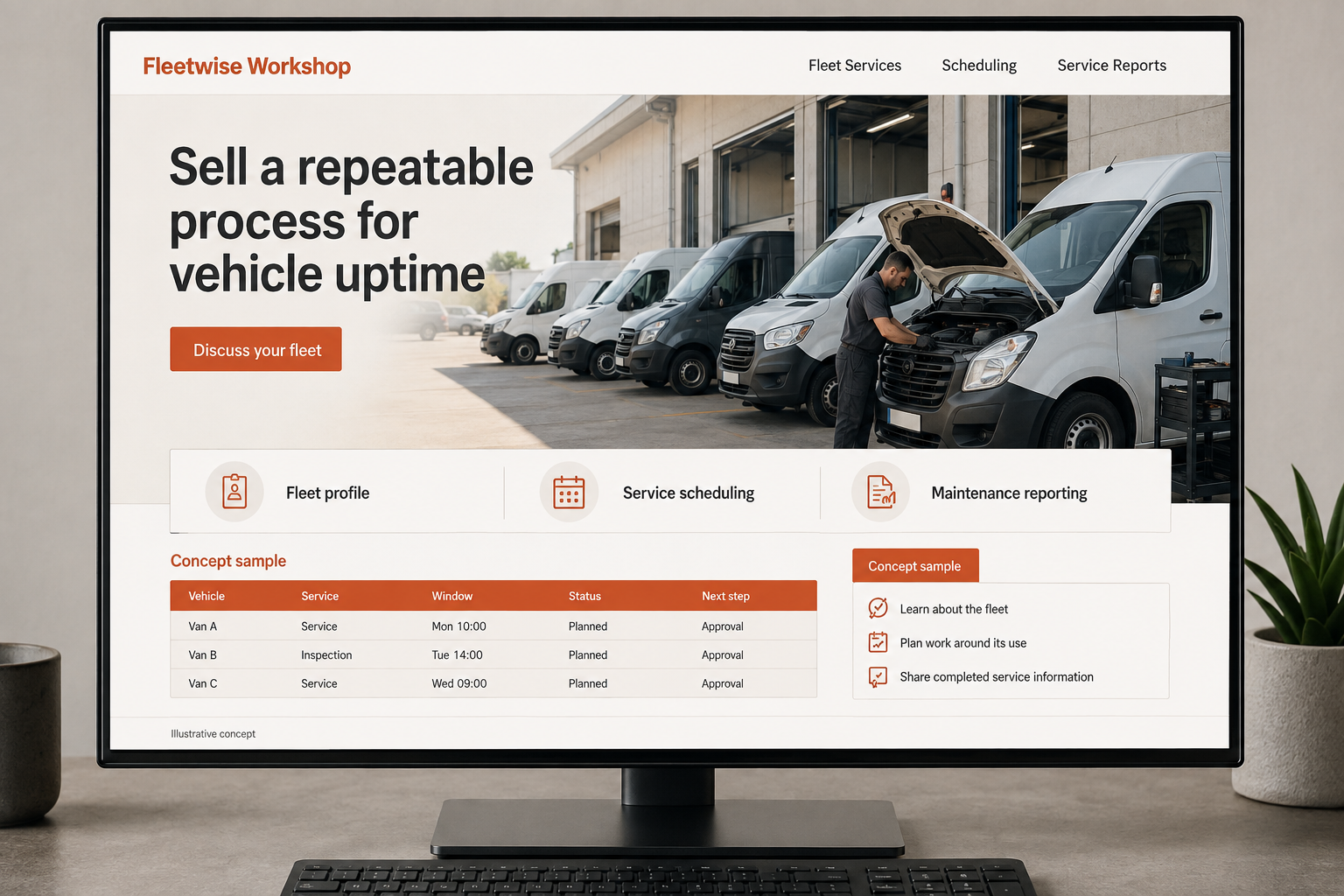
Explore this layout
Sell a repeatable process for vehicle uptime
Explore fleet profile, service scheduling, and maintenance reporting.
The main action is “Discuss your fleet”. Supporting sections cover Fleet profile, Service scheduling, Maintenance reporting.
Keeping several vehicles in service involves schedules, approvals, and records as well as repairs. A fleet-maintenance website should speak to the person coordinating those moving parts. Show how the workshop learns about the fleet, plans work around its use, and shares completed service information, then ask for a useful account profile instead of treating every visitor as a one-vehicle repair booking.
Speak to the person coordinating the fleet
A fleet manager needs to understand service coverage, scheduling, and reporting across multiple vehicles. Organize the site around the vehicle types and work the business actually supports. Separate one vehicle repair requests from ongoing fleet discussions. Avoid promising that no vehicle will ever be unavailable. A clear overview should show how the shop learns about the fleet and its use before proposing an arrangement that fits the customer’s operating pattern and maintenance needs.
Show the recurring process and records
Explain how work is scheduled, approvals are handled, and completed service information is shared. A fictional report example can demonstrate the format without exposing customer data. State what the business tracks and which responsibilities remain with the fleet operator. Buyers comparing providers need to see how communication works when several vehicles need attention. A list of repair services alone does not explain the coordination that makes an ongoing fleet relationship different from a single workshop visit.
Ask for a fleet profile
A useful inquiry requests vehicle types, approximate count, operating area, and the services being considered. Let the customer describe scheduling constraints and the current maintenance arrangement. Avoid requesting driver personal information or detailed vehicle records in the initial form. Explain whether the next step is a call or site discussion. The aim is to assess fit and plan a more detailed review, rather than quote a universal maintenance package from vehicle count alone.
Measure accounts that fit the operation
Track fleet inquiries separately from individual repair bookings and review which become suitable ongoing discussions. Repeated requests for unsupported vehicle classes should prompt clearer scope language. Content about preparing a fleet service brief can help operations staff gather the right questions before contact. Link it to the fleet page. Judge the website by qualified account conversations and clearer onboarding expectations, not simply the number of vehicles pictured or the volume of generic repair traffic it attracts.
Before you launch
- Separate fleet account inquiries from individual repairs.
- Show an anonymized or fictional service-report example.
- Ask about scheduling constraints in the fleet profile.
- Explain who approves additional work on a vehicle.
Can a fleet-maintenance plan be priced from vehicle count alone?
Vehicle count is a starting point, but types, usage, service scope, scheduling, and reporting requirements can change the arrangement. Let the website collect a concise profile and explain the next review. A headline price should state its assumptions rather than implying that any fleet of the same size needs identical support.